What if some of the experiences you've spent years wishing had never happened weren't meaningless?
The relationship that broke you. The career that suddenly stopped making sense. The person who keeps pushing the same emotional button. The decision you wish you could make again.
Maybe the more interesting question isn't simply, "Why did this happen to me?"
Maybe it's:
"What is this experience asking me to learn?"
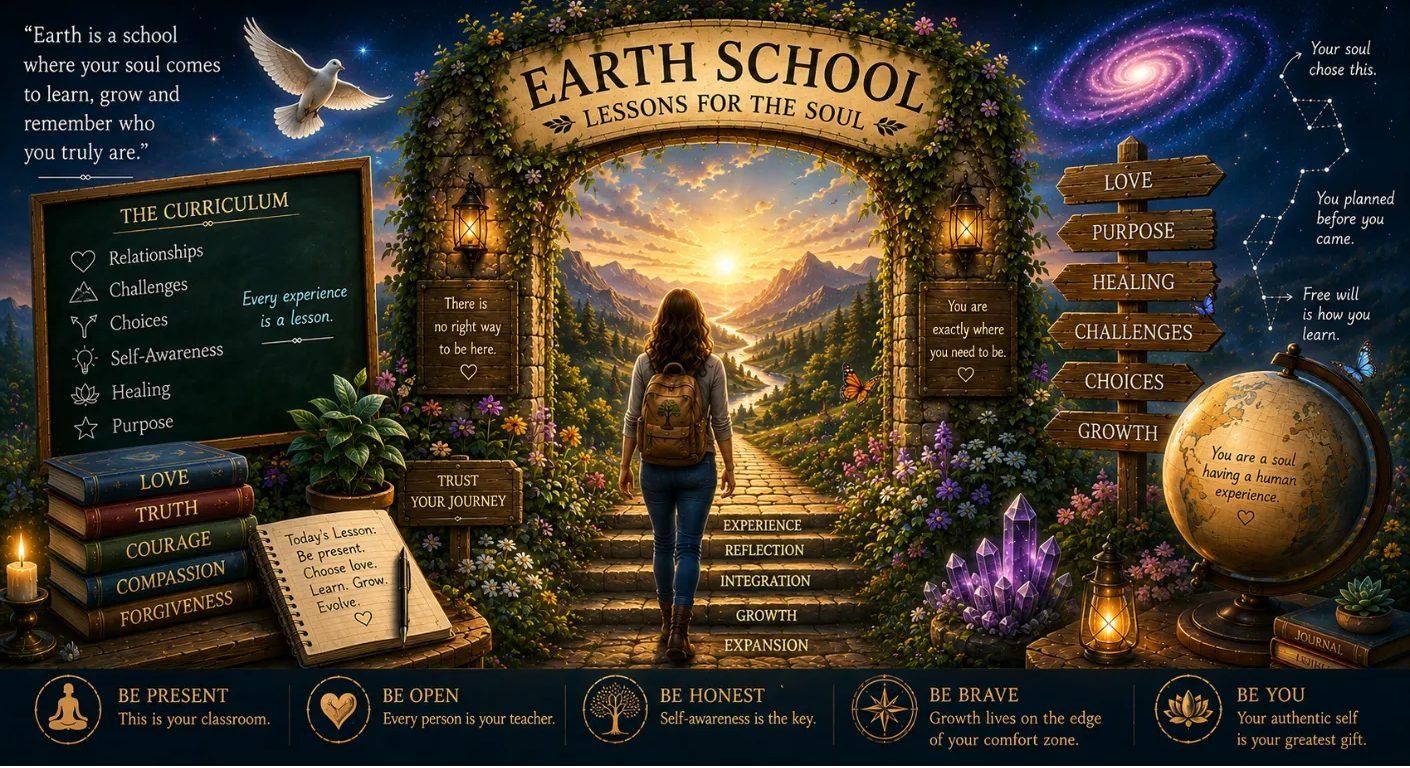
That question sits at the heart of a spiritual idea sometimes called Earth School: the belief that human life is not simply something we endure until it ends. It is an environment in which consciousness learns through experience.
And if you look at life through that lens, something interesting happens.
The circumstances don't necessarily change.
But the questions you ask about them do.
What Does "Earth School" Mean?
The basic idea is surprisingly simple.
Imagine Earth as a classroom, although probably not one with neat rows of desks and a teacher handing out gold stars.
Life itself is the classroom.
Your relationships are part of the curriculum.
So are disappointment, love, fear, success, rejection, uncertainty, forgiveness, loss, courage, temptation and choice.
In teachings associated with Bashar, channeled by Darryl Anka, this idea has been described as the "University of Earth." Earth is presented as a place where individuals develop and gain insight through lived experience.
The important word is experience.
You can understand forgiveness intellectually.
It's quite another thing to forgive someone who hurt you.
You can read a hundred books about courage.
It's different when you're terrified and still have to decide what to do.
You can say that you love yourself.
Then someone rejects you, and suddenly you discover whether your sense of worth belonged to you or depended upon them.
Knowing something and becoming it are not necessarily the same thing.
That may be one of Earth School's most interesting ideas.
Your Life Doesn't Have the Same Curriculum as Mine
If Earth is a school, we're apparently not all taking the same classes.
One person's lesson may involve learning independence.
Another person's may involve learning to accept help.
One person may need to speak up.
Another may need to listen.
Someone may spend years learning when to hold on.
Someone else may spend those same years learning when to let go.
This creates an important contradiction:
Advice that transforms one person's life can be completely wrong for another person.
That's why comparison can become such a trap.
You may look at someone your age and think:
They have the marriage.
They have the money.
They found their purpose.
They seem to have figured everything out.
Why am I so far behind?
But that assumes everyone was given the same assignment.
Earth School offers another possibility:
Maybe you're not behind. Maybe you're taking a different course.
That doesn't mean every painful circumstance was deliberately arranged for you, or that you should remain in harmful situations because they are supposedly "lessons."
It means you can ask what an experience is teaching you without pretending the experience itself was good.
That distinction matters.
The People Who Challenge You May Teach You the Most
Some of life's most powerful lessons arrive disguised as other people.
Think about someone who repeatedly triggers you.
Before deciding that this person was cosmically assigned to you, ask a more practical question:
What does my reaction to this person reveal about me?
Maybe they expose your need for approval.
Maybe you have trouble establishing boundaries.
Maybe you're afraid of abandonment.
Maybe you keep trying to rescue people who don't want to be rescued.
Maybe you're discovering that loving someone and allowing them unlimited access to your life are two very different things.
The other person doesn't even have to know they're teaching you something.
Sometimes the lesson isn't about changing them.
It's about finally seeing yourself.
What If the Lesson Keeps Repeating?
This is where the Earth School metaphor gets especially interesting.
Have you ever changed the person, job or situation only to discover the same basic problem wearing a different outfit?
Different relationship.
Same insecurity.
Different boss.
Same resentment.
Different circumstance.
Same fear.
It can feel as though life keeps circling back to the same chapter.
A spiritual interpretation might say that an unresolved lesson continues presenting itself until something changes within us.
Psychology offers less mystical explanations for some repeating patterns. People can carry learned behaviors, expectations, attachment patterns and beliefs into new relationships and circumstances.
Those explanations don't necessarily have to compete.
You can ask both questions:
"What pattern am I repeating?"
and
"What might this experience be teaching me?"
The useful part isn't proving that the universe sent the lesson.
The useful part is recognizing the pattern.
Because once you can see a pattern, you have a chance to choose differently.
Earth School Isn't About Blaming Yourself
There is a dangerous version of this philosophy that should be rejected.
It sounds something like:
"Everything happens for a reason, so you must have chosen every terrible thing that happened to you."
That can turn spirituality into blame wearing prettier clothes.
We do not need to tell someone experiencing illness, abuse, grief, violence or tragedy that they somehow "needed" the experience.
We don't know that.
Earth School becomes far more useful when treated as a way of responding to life, rather than an explanation that claims to know why every event occurred.
Instead of:
"I caused this."
Ask:
"Given that this happened, who do I want to become now?"
That is a very different question.
One produces blame.
The other creates choice.
The Real Test May Be Choice
If every answer were obvious, Earth wouldn't be much of a school.
Some of the most consequential moments in life don't announce themselves.
There is no booming voice saying:
FINAL EXAM. CHOOSE CAREFULLY.
It might simply be the moment when you decide whether to call someone.
Whether to tell the truth.
Whether to stay.
Whether to leave.
Whether to forgive.
Whether to repeat the familiar pattern or do something frighteningly different.
Whether to choose what other people expect or finally acknowledge what you know about yourself.
Most of life is built from ordinary decisions.
And perhaps that's where the real curriculum lives.
What Changes When You Start Living This Way?
You stop asking only:
"Why is this happening to me?"
And begin asking:
"What can I understand from this?"
You stop assuming someone else's timeline proves something is wrong with yours.
You become more interested in your patterns.
You begin noticing what repeatedly triggers you.
You pay attention to choices that once seemed insignificant.
You may even start looking at mistakes differently.
A mistake doesn't have to become your identity.
It can become information.
Earth School doesn't require a perfect student.
In fact, if growth is the point, perfection would make the entire exercise rather useless.
Maybe You Didn't Come Here to Get Everything Right
Perhaps you came here to experience.
To choose.
To discover what love means when loving is difficult.
To understand courage by first knowing fear.
To learn boundaries by discovering what happens without them.
To understand yourself by occasionally becoming someone you no longer want to be.
Whether Earth is literally a school for souls is a spiritual question, not something science has established.
But the metaphor leaves us with a remarkably practical question.
Think about the most difficult recurring situation in your life right now.
Don't ask:
"Why does this always happen to me?"
Ask:
"If there were something here for me to learn, what would it be?"
Don't force an answer.
Just notice what comes up.
Because perhaps Earth School isn't about finding the correct answer to life.
Perhaps it's about becoming conscious enough to recognize the question.
Where We Go Next
And that raises a much bigger question.
If Earth is a school...
why would a soul choose to come here in the first place?
Why experience limitation, uncertainty, heartbreak, fear and loss if consciousness could exist without them?
That is where the Earth School idea becomes considerably more interesting.